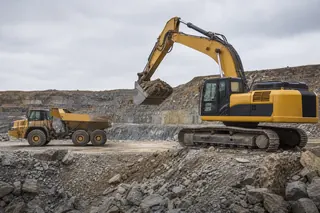
A wheel loader scale should be chosen from the loading decision it must support—not from a headline capacity or accuracy figure. Before asking for a quotation, define four things: the exact machine and attachment, the cycle in which a weight will be accepted, the payload decision the operator must make, and the record that the business needs afterward. If any one of those is vague, two quotations that appear comparable may describe very different systems.
This guide is for buyers preparing a new installation or retrofit for internal payload control, production reporting or a connected loading workflow. It does not replace the loader manufacturer’s instructions, a site risk assessment, an approved installation procedure or the legal-metrology decision of the competent authority. It also does not establish the performance or approval status of any FMSCales model. Those points must be confirmed for the quoted hardware, machine, jurisdiction and intended use.
Begin with the decision, not the scale
The first sentence in a useful specification is not “We need a 10-ton loader scale.” It describes the operational action that follows the displayed result.
For example:
- The operator stops adding material when the truck total enters an agreed target band.
- The quarry records tonnes by truck, material and shift for internal production control.
- A recycling yard records each container movement against a job number.
- A plant checks bucket totals against a downstream process record.
- A seller intends to determine a commercial quantity directly from the loader reading.
These are not equivalent requirements. The first may need dependable in-cab guidance and a clear target display. The second needs identifiers, record storage and a reconciliation rule. The final example raises legal-control questions that cannot be answered by adding a printer or by showing a generic certificate.
A buyer can keep the early discussion disciplined with one line:
The system will measure ______ during ______ so that ______ can decide ______, and the accepted result will be recorded in ______.
If the operations, procurement and IT teams complete that sentence differently, resolve the disagreement before comparing products. A scale can be technically functional and still fail the project because it produces the wrong record, asks the operator to act at the wrong moment, or sits outside the company’s approved transaction route.
Use four requirement files: machine, cycle, payload and data
Treat the selection process as four connected files. Each one answers a different procurement question.
| Requirement file | Question it must answer | What goes wrong when it is missing |
|---|---|---|
| Machine | Can the proposed sensing, display, power and installation route be approved for this exact loader and attachment? | A kit is quoted from rated capacity alone, then requires redesign, compromises access or conflicts with the machine configuration. |
| Cycle | At what movement and under what conditions will a reading become an accepted bucket or truck result? | Operators use different lift paths, unstable readings are stored, or the scale interrupts production. |
| Payload | Which minimum, normal, maximum and exceptional loads must the system distinguish, and what action follows? | Capacity is oversized, useful resolution is lost, overload cases are misunderstood, or performance is judged with an unrepresentative test. |
| Data | Which fields, users and systems need the result, and what happens when an ID, network or printer is unavailable? | The display works, but records cannot be reconciled, exported or audited. |
The files should be reviewed together. A requested truck ticket changes the operator cycle. A second bucket changes the machine and calibration scope. A cloud report changes user access, connectivity and recurring cost. A legal-use requirement may change the acceptable instrument route completely.
1. Build a machine compatibility file that another engineer can review
“Wheel loader, 5-ton capacity” is not enough information for a responsible proposal. At minimum, record the manufacturer, model, serial number or product identification, year, rated operating information, current bucket or attachment, quick coupler if fitted, relevant hydraulic arrangement, cab voltage and available mounting space. Photograph the identification plate, both sides of the lift arms, the bucket linkage, accessible hydraulic lines and the proposed display area. If several loaders may receive the same system, create one file per machine; do not assume that adjacent serial numbers or similar badges have identical plumbing, software or cab layouts.
The supplier should explain the proposed measurement architecture in plain language. Some systems use hydraulic pressure and position information to estimate the load during a defined lift. Caterpillar, for example, describes one of its own wheel-loader payload systems as calculating material weight from bucket-position and hydraulic-pressure sensor data. That is evidence for how that specific OEM system works, not proof that every retrofit uses the same sensors or processing.[1] Ask each bidder to identify the sensors, signal source, measurement window, mounting points and any machine data it requires.
Compatibility review should include changes that may occur after commissioning:
- alternative buckets, forks, grapples or high-tip attachments;
- quick-coupler changes;
- hydraulic repair or component replacement;
- tyre-size or configuration changes where relevant to the approved setup;
- replacement of the display, controller, sensor or firmware;
- movement of the system to another machine.
The proposal must state which changes require a new setup, verification or calibration. “Fits most loaders” is not an acceptance criterion.
There is also a responsibility boundary. A scale supplier can propose a route, but hydraulic, electrical, structural and machine-control work must follow the applicable manufacturer information and be completed or approved by competent parties. The buyer should identify who authorizes the modification, who owns the machine warranty discussion, who installs the hardware and who signs the handover. This guide cannot determine those responsibilities for a specific machine.
Factory-integrated, dealer-integrated or retrofit?
Do not treat these routes as a simple good–better–best ladder.
A factory- or OEM-integrated option may have direct access to machine information and a display already designed into a supported model, but availability can be limited by model, year, region and option package. An aftermarket route may cover a mixed fleet and provide a common workflow, but it needs a documented compatibility survey and clear installation responsibility. A dealer-integrated route may reduce coordination for a supported machine, yet the buyer still needs to understand data ownership, subscriptions and service coverage.
The right question is: Which route can provide traceable compatibility evidence, an acceptable operating workflow and support over the intended machine life?
2. Map the loading cycle before choosing the weighing mode
Walk beside the operation—outside the machine’s exclusion zone and under the site’s safety rules—and map one complete cycle. Record where the bucket is filled, how far the loader travels, whether the machine turns while lifting, where the operator can see the receiving truck, when material is tipped off, and when the result is stored. Include a normal cycle and the awkward cases: partial buckets, wet or sticky material, a truck that moves, a rushed final pass, a changed stockpile face, poor ground and a shift change.
Then ask the bidder to mark the proposed weighing window on that cycle. The answer should be specific enough for an operator and an acceptance tester to recognize the same event. OEM examples show why this matters. Caterpillar’s published operator sequence for one system tells the operator to tilt the bucket back, lift at a consistent speed and wait for the interface to indicate that weighing is complete.[2] That sequence is not a universal instruction for other products; it illustrates that a dynamic loader reading belongs to a defined movement rather than an arbitrary point in the work cycle.
Use a short observation sheet:
| Cycle item | Normal condition | Exception to test | Procurement implication |
|---|---|---|---|
| Dig and fill | Typical material and bucket fill | Low-density, wet, sticky or mixed material | Include representative materials in commissioning. |
| Travel | Distance, surface and turning pattern | Rough approach or simultaneous steering/lifting | Confirm when weighing is permitted and how an invalid cycle is shown. |
| Lift | Usual speed and lift height | Fast, hesitant or interrupted lift | Require an operator prompt and an acceptance rule. |
| Final adjustment | Full pass, partial pass or tip-off | Material returned to pile or truck | Confirm how subtraction and revised totals are handled. |
| Dump and store | Automatic or operator-confirmed | Missed dump, double count or wrong truck ID | Define latch, correction and audit behavior. |
| Shift handover | Operator, job and target selected | Previous job remains active | Define login, reset and open-job controls. |
Keep this article’s selection role separate from calibration work. Once the buyer has selected a viable operating route, the existing wheel loader scale calibration and operating-conditions guide should be used to plan warm-up, controlled lift conditions, verification and drift investigation. A buying guide should require that procedure; it should not invent adjustment instructions for an unknown system.
3. Describe the payload range as a decision profile
Rated loader capacity does not describe the measurement task. Build a payload profile from actual operations:
- lightest bucket result that must influence a decision;
- normal bucket range for each dominant material;
- heaviest expected bucket within the machine’s authorized operating limits;
- target truck or container total;
- normal number of passes;
- acceptable final-load decision band set by the operation;
- unusual loads, attachments or materials that need a separate configuration;
- units, rounding and display increment required by the users;
- whether bucket weights, accumulated truck weights or both are retained.
Do not select capacity by adding an arbitrary safety percentage to an average bucket. Use the machine manufacturer’s operating limits, the real attachment and the heaviest credible operating case. The weighing system is not a device for authorizing a machine overload. Likewise, a larger display capacity does not make an unsafe load acceptable.
Accuracy language also needs discipline. Ask every bidder to express claimed performance with the load range, material, machine state, attachment, ground, lift procedure, reference method, number of tests, calculation method and environmental limits. A percentage without those conditions is not comparable. “Typical,” “up to” and “under ideal conditions” are not acceptance statements.
Separate three questions:
- Resolution: What is the displayed increment, and is it meaningful for the smallest decision the operator must make?
- Repeatability: Under a controlled, representative cycle, how closely do repeated results agree?
- Agreement with the reference: Under the agreed test, how close are loader results to the traceable or otherwise suitable reference result?
These are related but not interchangeable. The buyer should not infer installed accuracy from a sensor datasheet, a display division or a single demonstration load. The complete system and procedure must be tested.
4. Choose the record before choosing the interface
A buyer who asks only for “Wi-Fi” or “API” has specified a transport method, not a working record. Begin with one accepted loading event on paper. Which fields make it useful and auditable?
A practical record may need:
- site, loader and device identity;
- operator or shift;
- material or product code;
- truck, container, customer, order or job identity;
- individual bucket values and accepted truck total;
- unit, timestamp and time-zone rule;
- target, tolerance or status;
- manual correction, cancellation or exception reason;
- configuration or verification status where required;
- destination system and acknowledgement state.
Only then compare display-only, printed, local export, fleet portal and ERP-connected routes. Published OEM capabilities show the range of possibilities: Caterpillar lists truck ID, material type, customizable lists, optional printing and online reporting for particular configurations and subscriptions.[1] John Deere states that payload data from its SmartWeigh option can be made available through JDLink or its operations platform on supported machines.[3] These are examples of specific ecosystems. They do not establish that a quoted FMSCales configuration provides the same fields, cloud service or integration.
For each proposed data route, ask:
- Which exact fields are created by the indicator, and which are entered by an operator or another system?
- Is a stable weight event distinct from a completed truck transaction?
- What happens when the network is down?
- Can a record be edited, and is the original retained?
- How are duplicate dumps, wrong IDs and cancelled loads handled?
- Who owns the data and can export it in a usable format?
- Are portal, SIM, printer, API or software fees recurring?
- How long is data retained, and who administers user access?
- What interface document and sample record will be supplied before integration work begins?
ISO/TS 15143-3:2020 defines a server-to-customer-application telematics communication schema for certain mobile machinery status data, but its published scope explicitly excludes onboard collection, the onboard protocol and wireless transmission from the machine to the provider’s server.[4] Therefore, citing that specification does not answer how a payload value is generated inside a loader or whether a particular portal exports the business fields above.
If the project needs PLC, ERP, WMS or custom API design, keep this guide at selection level and move the detailed field ownership, protocol map and failure testing to the weighing data integration guide.
5. Separate process guidance from legally controlled measurement
Ask early whether the result is used only for internal loading control, for operational records, to prepare a shipment, to determine a commercial quantity, or for enforcement. The answer may change the instrument, approval, verification, installation and record requirements.
Never infer legal-for-trade status from the words “industrial scale,” from CE marking alone, from a component certificate, or from another model in the same brochure. The distinction is visible even within OEM product lines. Caterpillar states that its described standard wheel-loader Payload technology is not legal for trade.[1] Volvo CE, by contrast, announced a certifiable onboard weighing route for selected loader models with specified equipment in certain EU markets, referring to OIML R 51 and the EU Measuring Instruments Directive.[5] These examples prove that approval is configuration- and market-specific; they do not prove anything about a different system.
OIML R 51-1:2006 covers automatic catchweighing instruments subject to national metrological control and sets metrological and technical requirements and tests.[6] In the EU, Directive 2014/32/EU includes automatic weighing instruments under MI-006, but national putting-into-use, verification and market-specific obligations still need confirmation.[7] In the United States, NIST publishes Handbook 44 as a model set of technical requirements, while state or local authorities decide what is adopted and applied.[8]
Before accepting any approval claim, request:
- exact instrument and software identification;
- certificate number and issuing body;
- complete certificate and annex, not a cropped cover page;
- approved sensor, indicator, printer and software combinations;
- machine models, attachments and operating modes within scope;
- accuracy class, measurement range and environmental limits where stated;
- required seals, markings, installation and verification steps;
- country and intended-use confirmation from the competent route;
- obligations after repair, software update, machine transfer or attachment change.
If those items are not available, keep a suitably approved reference weighing route for the regulated transaction and use the loader result only within the documented internal purpose. The buyer, importer, local service organization and competent authority must determine the final legal-use route.
6. Match the requirement level—not a marketing package name
The following matrix is a buyer-planning tool, not a list of FMSCales product tiers.
| Requirement route | Suitable when | Minimum evidence to request | Common hidden cost |
|---|---|---|---|
| In-cab target guidance | One machine loads to internal targets and a separate system remains the official reference | Machine compatibility, defined lift cycle, display behavior, representative site verification and operator training | Installation downtime, attachment changes, repeat verification and service travel |
| Managed production records | Supervisors need material, truck, job, operator or shift totals | All guidance-route evidence plus identifier workflow, correction rules, export example, retention and reconciliation method | Printer supplies, local software, shift administration and record cleanup |
| Connected fleet workflow | Multiple machines or sites feed a portal, dispatch process or business system | Data dictionary, interface document, offline behavior, security ownership, test environment and integration acceptance plan | Subscription, mobile data, API work, identity management and long-term vendor dependence |
| Legally controlled route | The loader result determines a regulated commercial or enforcement quantity | Exact approval scope, local acceptance, markings, seals, verification, controlled software and ongoing compliance responsibility | Conformity work, inspection, authorized service, reverification and configuration restrictions |
One operation may use more than one route. For example, an in-cab system can guide loading while a weighbridge remains the commercial reference. That is not duplication if the business defines which record controls which decision.
7. Compare lifecycle cost with a simple operational model
Hardware price is only one line in the comparison. Ask bidders to separate:
- equipment and options;
- survey and engineering;
- installation labor and travel;
- machine downtime;
- commissioning and reference equipment;
- operator and administrator training;
- printer, tickets, mounts, guards and cabling;
- subscription, SIM, portal, API or license charges;
- periodic verification and recalibration;
- service response, spare parts and warranty exclusions;
- reconfiguration after bucket, hydraulic or machine changes;
- data migration or export at contract end.
Estimate value with your own operating data rather than a supplier’s generic savings percentage. Over a representative period, record correction passes, trips to a fixed scale, truck reloads, rejected or disputed records, manual data entry and time spent reconciling material totals. Multiply each event by the site’s measured time and cost. Then compare that baseline with the process the proposed system would actually remove or shorten.
Do not count a benefit twice. If the loader system reduces a trip to a check scale, the same minutes cannot also be claimed as a separate cycle-time saving. Do not assume every operator, material or shift will achieve the result of a demonstration. A credible business case shows the baseline, proposed process, adoption assumptions, recurring costs and a sensitivity range.
8. Put acceptance criteria into the purchase order
The strongest time to agree how the system will be judged is before the purchase order, not when the installer arrives.
The acceptance plan should identify:
- the exact loader, attachment, hardware and software configuration;
- reference method and responsibility for providing it;
- materials and loads that represent normal and difficult work;
- machine warm-up and inspection prerequisites;
- ground, lift path, speed range and operator procedure;
- number and sequence of test loads;
- calculation and acceptance limits approved by the buyer and responsible technical parties;
- invalid-test and retest rules;
- ticket, export or integration records to be demonstrated;
- training, handover documents and signatories;
- conditions that trigger reverification;
- open items that remain excluded from acceptance.
Avoid a purchase order that says only “accuracy: ±X%” without defining the basis. Is X a percentage of the applied load, full scale, bucket value or truck total? Does it describe a maximum error, an average, repeatability or a marketing example? At what load and under which operating conditions? If the proposal cannot answer those questions, the number is not ready for a contract.
9. Send the same RFQ package to every bidder
Use this checklist to make quotations comparable. It is an editorial draft and requires FMSCales engineering approval before it becomes a controlled download.
Machine
- Manufacturer, model, year and identification-plate photograph
- Rated information and relevant manufacturer documentation
- Bucket, fork, grapple, high-tip bucket or other attachments, including quick coupler
- Attachment dimensions and identification where available
- Hydraulic diagram or service information that the owner is authorized to share
- Photographs of lift arms, linkage, hydraulic routes, cab and proposed display position
- Cab power, fuse and communication constraints
- Machine warranty, dealer-approval and installer requirements
- Other machines or attachments expected during the system life
Cycle and site
- Material pickup, travel, lift, tip-off, dump and record sequence
- Cycles per hour or shift and truck types served
- Typical ground, slope, vibration, dust, rain, washdown and temperature conditions
- Normal and exceptional operator actions
- Safe installation and service access
- Shift-change, job-change and wrong-ID handling
- Available reference weighing method and commissioning window
Payload
- Minimum decision-relevant bucket load
- Normal and maximum expected bucket range for each material
- Target truck, container or batch total
- Typical pass count and final-pass method
- Required unit, display increment and target rule
- Internal guidance, production reporting, transaction or enforcement purpose
- Proposed acceptance method and conditions
Data and service
- Required fields and a sample accepted record
- Display, print, local export, portal or business-system destination
- User roles, edit rights, audit and retention needs
- Offline, duplicate, cancellation and recovery behavior
- Required interface documents and test environment
- Language, training and handover documents
- Installation, commissioning, verification and maintenance responsibility
- Warranty, response time, spares and update policy
- One-time and recurring charges
A useful quotation should return this package with three statuses beside every line: confirmed, excluded, or TBC with owner and due date. That is more informative than a brochure containing many features that were never matched to the application.
10. Test the proposal for five procurement red flags
1. Compatibility is approved from capacity alone
Loader capacity is necessary, but it does not identify attachment geometry, hydraulic route, sensor positions, cab integration or service responsibility. Require a machine-specific statement.
2. Accuracy appears without conditions
Ask for load range, machine state, reference, procedure, test count, calculation and environmental limits. If these are absent, treat the number as unverified for your site.
3. A protocol name replaces an integration specification
“Modbus,” “API,” “cloud” or “Wi-Fi” does not define fields, register mapping, security, offline operation or acceptance tests. Request the exact interface document for the quoted version.
4. A generic certificate is presented as market approval
Match the model, options, software, certificate annex, jurisdiction and intended use. Confirm putting-into-use and verification responsibilities locally.
5. Commissioning ends when the display turns on
Power-up is not acceptance. The handover should demonstrate representative loads, operator exceptions, records, training and agreed documentation.
Make the shortlist only after the evidence is comparable
A sensible shortlist does not begin with the bidder that promises the smallest error or the longest feature list. It begins with proposals that clearly identify the machine configuration, measurement cycle, payload range, record route, approval boundary, acceptance method and lifecycle responsibility.
For an internal quarry-loading project, that may lead to a straightforward in-cab guidance system with disciplined site verification. A multi-material recycling operation may place more value on job codes, corrections and exportable records. A commercial transaction may require a specifically approved onboard configuration or a separate approved reference scale. These are modeled scenarios, not FMSCales case claims.
Review the available wheel loader scale product routes only after completing the requirement files. For projects that combine loader, conveyor and vehicle weighing, use the mining and quarry application page to map where each decision belongs. When ready to request a technical review, submit the machine photographs, cycle description, payload profile, sample record and intended-use statement through the request-a-quote page. The expected first response should distinguish what can be confirmed from supplied evidence, what is excluded and what still requires engineering or local metrology confirmation.
Frequently asked questions
Can the proposed sensing, display, power and installation route be approved for this exact loader and attachment?
Shortlist a system only after the machine, cycle, payload decision, record route, responsibilities and site acceptance method are comparable across bids.
References
The following official and first-party sources support the bounded examples, standards context and evaluation methods used in this guide. They do not verify an FMSCales configuration.
- Caterpillar — Cat Payload for Wheel Loaders
- Caterpillar — How to Use Cat Advanced Payload with Assist
- John Deere — 644 P-Tier Wheel Loader Specifications
- ISO/TS 15143-3:2020 — Worksite data exchange, Part 3
- Volvo CE — Certifiable On-Board Weighing for selected wheel loaders
- OIML R 51-1:2006 — Automatic catchweighing instruments
- EUR-Lex — Directive 2014/32/EU on measuring instruments
- NIST Handbook 44 — Current Edition
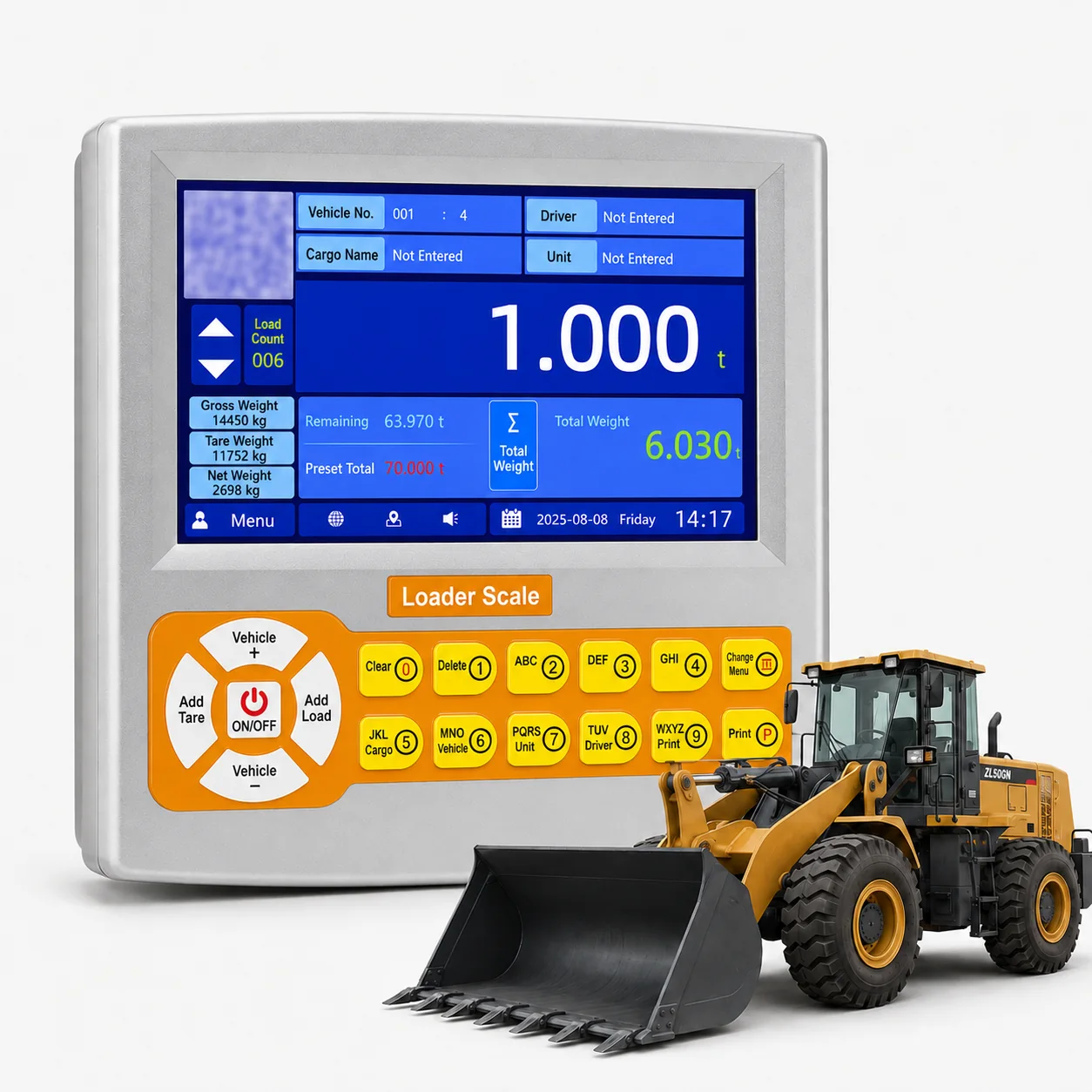 Loader Scales
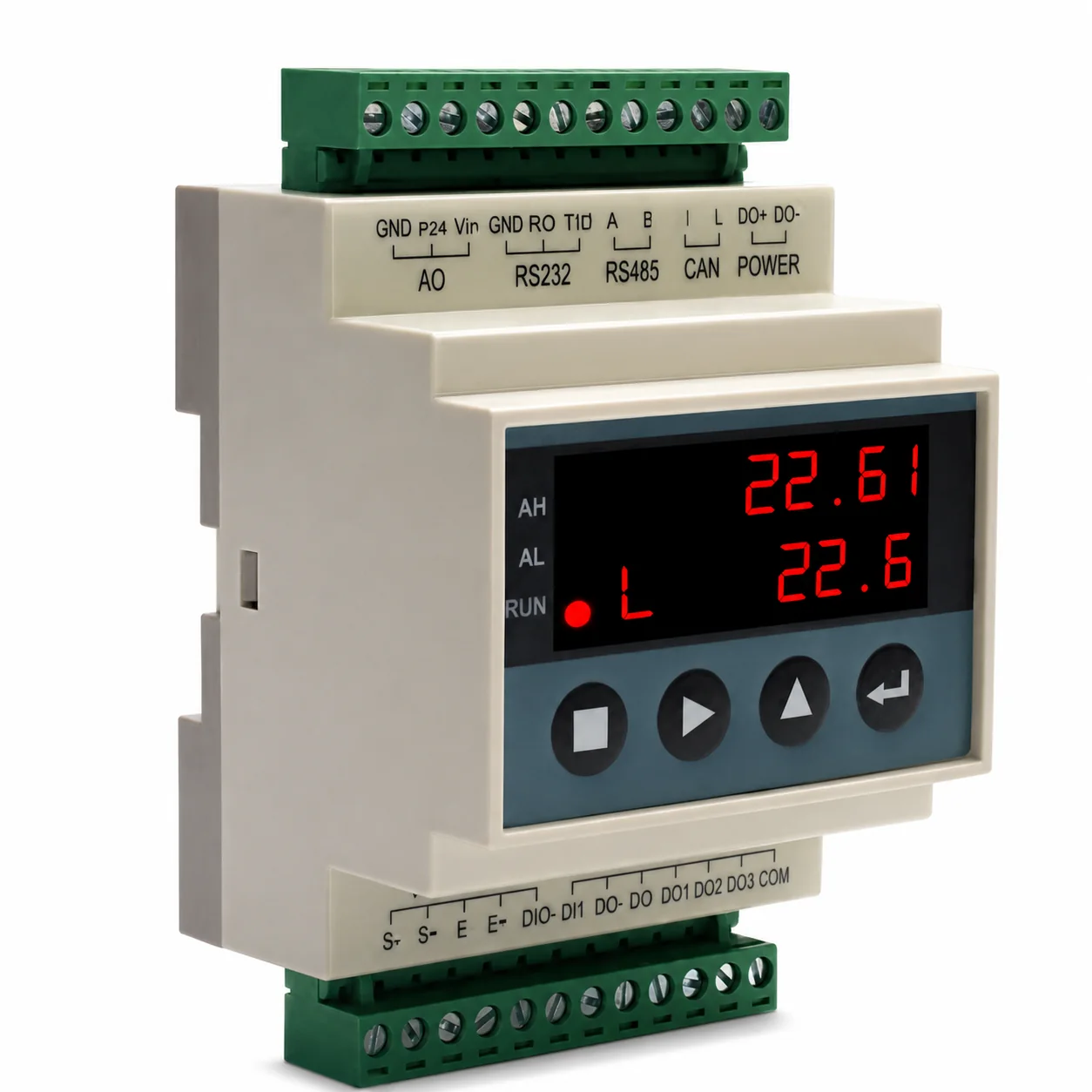 Weighing Indicators
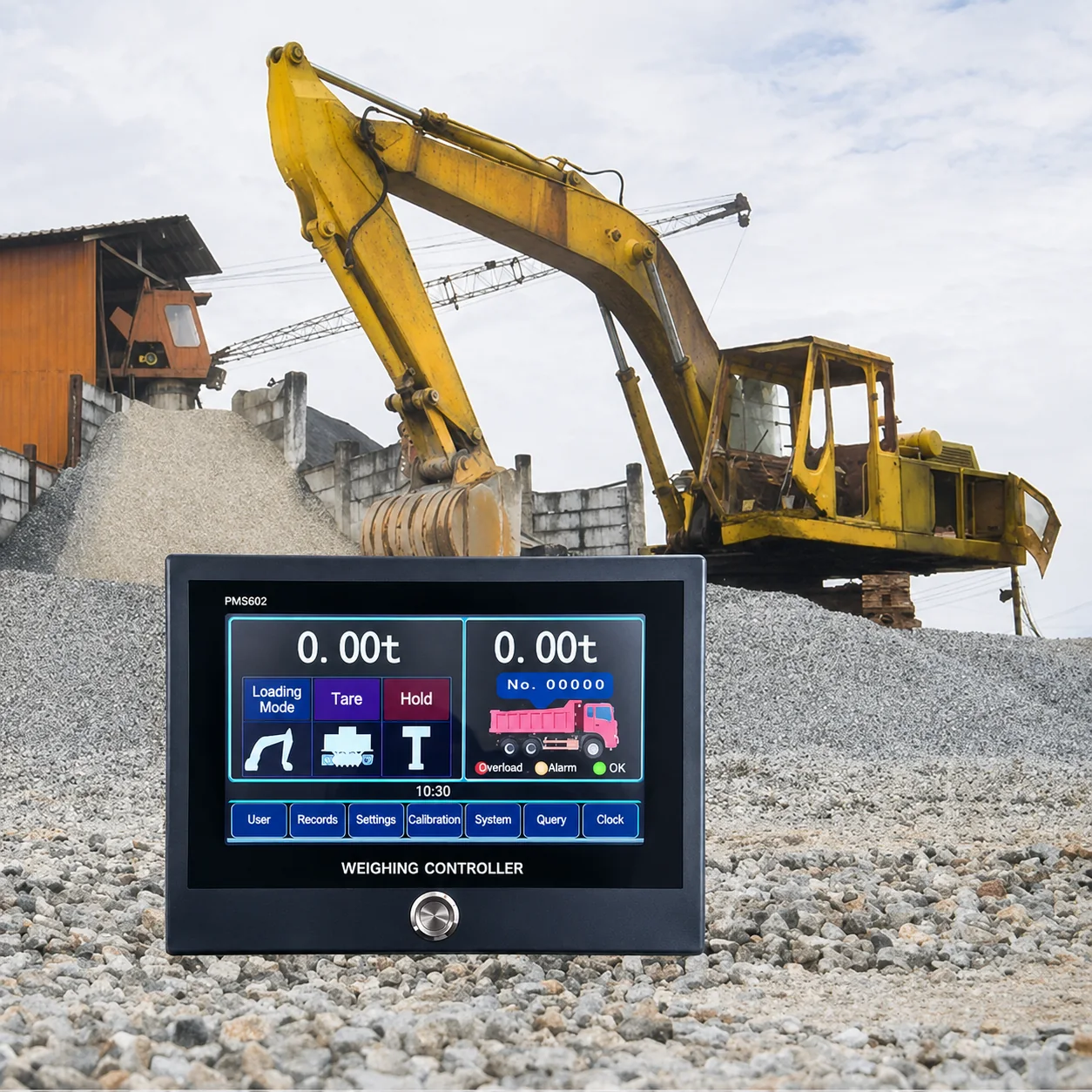 Excavator Weighing Systems