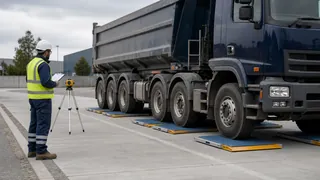
An excavator scale can look convincing during a short demonstration: the display changes as the boom rises, individual bucket loads accumulate, and the truck total approaches a target. That is not yet proof that the system is suitable for your operation. The purchasing question is whether the quoted configuration can produce a defensible result on your identified excavator, with the attachment and coupler actually used, through a repeatable work cycle, against an agreed reference, with exceptions handled correctly.
For most buyers, the safest route is to write the site acceptance test before issuing the purchase order. Define what the weight will be used for, freeze the machine and attachment configuration, agree how calibration and verification will be performed, and state the evidence required for handover. Do not accept a percentage labelled “accuracy” unless the quotation also states the load range, reference method, calculation basis, operating conditions, repeat count, attachment profile and pass/fail rule.
This guide is for process control, target loading, mass-haul records and internal production management. It does not establish that any FMSCales model is approved for commercial transactions, enforcement or statutory reporting. Those uses require evidence for the exact instrument and jurisdiction. One major excavator OEM, for example, explicitly labels its own payload technology “not legal for trade”; that statement is model-specific, but it demonstrates why a buyer cannot infer legal status from the words “onboard scale.” [4] For a U.S. project, NIST lists the 2026 edition of Handbook 44 as current and says a scale must be inspected and approved by an authorized state body before commercial use; that is one jurisdiction's route, not a worldwide rule or proof that this device type qualifies. [7][8]
Start with the decision, not the sensor kit
The same displayed tonne value can support very different decisions. A quarry supervisor may want to reduce obviously underloaded haul trucks. A civil contractor may need daily mass-movement estimates by cut and fill zone. A recycling operator may want material totals by job. A subcontractor may hope to invoice from the excavator record. These are not equivalent requirements.
Write one sentence describing the decision that follows the reading. Then classify it.
| Intended decision | What the system must demonstrate | Main procurement risk |
|---|---|---|
| Operator target-loading aid | Timely, stable guidance during the normal loading cycle | A display that works only in an artificial demonstration cycle |
| Internal production or mass-haul record | Complete, attributable totals with defined correction and reconciliation rules | Missing loads, double counts, wrong material/job IDs or unrecorded manual edits |
| Truck dispatch check | An agreed relationship to the site's independent dispatch reference | Treating an excavator estimate as a substitute for an approved weighbridge without evidence |
| Inventory or contractor reconciliation | Traceable records, retained raw data and a documented uncertainty/acceptance basis | Disputes caused by unclear ownership, reset rules or reference differences |
| Commercial transaction or enforcement | Exact-model approval, installation acceptance and continuing verification required by the jurisdiction | Assuming a component certificate or generic brochure makes the installed system lawful |
The classification determines the rest of the specification. If the reading merely helps an operator approach a truck target before a final weighbridge check, an agreed operational error band may be sufficient. If the record controls payment, the buyer needs a legal and metrological assessment before equipment selection, not after commissioning.
Also state what the onboard result is not allowed to do. It is not a replacement for the excavator's safe operating limits, load chart, overload warning, lift-planning controls or the operator's duties. Payload measurement and machine safety are related, but they are not interchangeable functions.
Freeze the machine configuration before comparing quotations
An excavator payload calculation is tied to a mechanical and hydraulic configuration. Official manufacturer descriptions show one common approach: the onboard computer combines hydraulic-pressure information with bucket or grapple position to calculate and accumulate payload. [4] This is useful context, not a universal design specification. A bidder must describe the measurement route used by the exact quoted system.
At minimum, the inquiry pack should identify:
- excavator manufacturer, model, serial-number range, operating mass and year;
- boom, stick and hydraulic configuration, including any non-standard changes;
- coupler make and model;
- every bucket, grapple or other work tool that needs an accepted weighing profile;
- attachment dimensions, nominal capacity, mass and wear condition;
- hydraulic schematic or approved pressure-test connection information, where available;
- existing machine-control, telematics, camera and display equipment;
- cab power, available protected mounting positions and cable routes;
- ambient temperature, rain, dust, vibration, washdown and corrosion exposure;
- normal dig, swing, lift and dump sequence;
- truck body types, loading position and target payload range.
Treat the coupler and attachment as configuration-controlled items. Some commercial systems advertise multiple attachment calibrations, which confirms that attachment identity is a genuine system variable; it does not prove how many profiles the proposed FMSCales configuration supports. [5] Ask the bidder to list the number of profiles, how operators select them, whether selection can be locked or logged, and what happens when an unrecognized attachment is fitted.
Photographs help, but they do not replace model plates, dimensions or a hydraulic review. A good quotation should return a compatibility statement that names the machine and attachment configuration reviewed. “Suitable for 20–40 tonne excavators” is not the same thing.
Make the supplier explain the measurement cycle
Buyers do not need access to proprietary algorithms, but they do need an operational explanation. The quotation should show where sensing occurs, what machine states make a reading valid, when a bucket load is accepted into the total, and how the system rejects an unsuitable cycle.
Ask the supplier to mark a typical loading cycle with these events:
- attachment identified and job/truck record opened;
- material captured;
- boom, stick or attachment enters the configured measurement region;
- hydraulic and position inputs meet the validity rules;
- individual load is calculated and displayed;
- load is committed to the truck or job total;
- partial dump, tip-off, rehandle or aborted cycle is corrected;
- truck record is closed, printed, exported or synchronized.
This discussion exposes differences that a feature list hides. Does the system weigh during a low lift, through a defined boom range, at a stop, or during a controlled movement? Can the operator tip off excess material without corrupting the truck total? What prevents the same bucket being counted twice during re-sorting? Does the display flag a cycle outside the accepted geometry, or does it always return a number?
An invalid-cycle rule is as important as the normal reading. Require the supplier to describe the visible warning, whether invalid attempts are logged, and the operator's recovery step. A silent, plausible number is more dangerous to a business process than an obvious error message.
Turn “accuracy” into a testable purchase requirement
Accuracy is not a self-defining brochure number. The buyer needs to know:
- whether error is evaluated per bucket, per completed truck, per shift total or against another basis;
- whether the denominator is the bucket load, indicated load, reference load, full-scale capacity or another quantity;
- the load range over which the claim applies;
- the reference instrument or method;
- the accepted attachment, temperature, machine state, site slope and operator cycle;
- how many repetitions and operators are included;
- whether the criterion applies to mean bias, maximum individual error, repeatability spread or all three;
- how rounded display values and data exports are handled.
For target loading, the completed-truck total may matter more than the worst single-bucket difference. For blending or small-batch work, individual-load behavior may be critical. The contract should test the result that drives the buyer's decision rather than whichever metric produces the most attractive percentage.
Use both absolute and relative views. A 100 kg difference has a different operational meaning on a 1 tonne attachment load and on a 25 tonne truck total. Conversely, a percentage alone can hide the size of a correction an operator must make. The acceptance sheet should retain the raw indicated value, reference value, signed difference and applicable percentage calculation.
Do not let the target tolerance appear for the first time on commissioning day. It must be agreed before award, based on the intended decision and a technically justified reference method. If the supplier cannot commit until a site survey, the quotation should state a provisional target, the survey dependency and the point at which the buyer may accept or reject the final proposal.
Keep calibration, adjustment, verification and legal approval separate
These words are often used as if they mean the same thing. They do not.
The international metrology vocabulary describes calibration as establishing, under specified conditions, the relationship between reference values and indications, then using that relationship to obtain a measurement result. It explicitly warns that calibration should not be confused with adjustment or verification. [1] Verification is the provision of objective evidence that specified requirements are fulfilled. [2]
Applied to an excavator project:
- Configuration identifies the machine, sensors, attachment profile, units, record fields and operating rules.
- Calibration establishes the system response using the manufacturer's documented process and a suitable reference.
- Adjustment changes settings so indications correspond as intended; it should be controlled, authorized and recorded.
- Site verification compares results with the written acceptance requirements under representative conditions.
- Legal verification or approval is a jurisdictional act for regulated use and cannot be created by the buyer's SAT signature.
Metrological traceability means that a result can be related to a reference through a documented, unbroken calibration chain, with each calibration contributing to uncertainty. [3] In practical procurement language, “we compared it with something heavy” is not enough. Identify the reference, its status, date, range, resolution, uncertainty or statutory verification evidence as applicable, and the procedure used to transfer the reference value to the excavator test.
A certified weighbridge may be a practical reference for completed truck loads, but it introduces its own controls: stable vehicle condition, gross/tare sequence, fuel and material changes, travel between systems, timing, drainage or material loss, and the weighbridge's current status. Known test material or another reference arrangement may be suitable for a different workflow. The project engineer must choose and document the method; this article cannot prescribe one universal reference.
Split factory review from site acceptance
For a retrofit excavator system, a factory acceptance test cannot reproduce the installed machine's hydraulic behavior, geometry, attachment and operator cycle unless the complete configured machine is actually present. Use FAT for what it can prove, and reserve installed performance for SAT.
What a useful pre-delivery or FAT review can cover
- quoted part numbers, revisions and quantities;
- display power-up, units, date/time and access levels;
- sensor, harness, bracket, connector and protection inventory;
- sample input/output behavior and error messages;
- attachment-profile creation and selection workflow, if supported;
- printer, USB, serial, wireless or network functions actually included in the quote;
- a sample record containing the agreed fields;
- local storage, export, offline queue and recovery behavior;
- configuration backup and restore method;
- installation drawings, manuals and training plan;
- open-item register for functions that can only be tested on the machine.
This review prevents missing hardware and software surprises. It does not earn a pass for field accuracy.
What SAT must establish
SAT should show that the installed system is safe to use within its stated role, matches the approved configuration, recognizes valid and invalid cycles, meets the agreed measurement criteria, produces complete records and leaves the site with an owned maintenance plan.
Use a matrix rather than a single comparison:
| Test block | Representative conditions to define | Evidence captured | Pass rule |
|---|---|---|---|
| Installation baseline | Exact machine, coupler, attachment, sensor locations, cable/hose routing and software revision | Photos, IDs, drawings, configuration export | Matches approved installation and has no unresolved safety or damage issue |
| Zero / empty check | Warm state, empty clean attachment, defined pose and cycle | Indications and repeat runs | Project-specific criterion agreed in the contract |
| Load-range verification | Low, normal and upper working bands using the normal material or justified reference | Bucket and/or truck totals paired to reference results | Project-specific criterion agreed in the contract |
| Repeatability | Same operator, attachment, material and controlled cycle | Consecutive raw results | Project-specific criterion agreed in the contract |
| Reproducibility | Operators, truck positions or representative site conditions that matter to the process | Grouped results with conditions identified | Project-specific criterion agreed in the contract |
| Exception handling | Partial dump, aborted lift, double movement, profile mismatch, communication loss or other supported exceptions | Screen behavior, flags and stored records | No unflagged accepted result for agreed invalid conditions |
| Data handoff | Print, export or integration using a real sample job | Source and destination records with IDs/times | Required fields complete; duplicates and offline recovery handled as specified |
| End-of-test check | Return to an agreed reference condition | Closing result and configuration checksum/export | No unexplained change from the accepted baseline |
The exact number of runs and tolerances belong in the contract. A practical plan includes repeated observations at more than one load band, but copying an arbitrary count from another machine creates false confidence. Choose enough trials to expose the variation that matters to the decision, and retain every result, not only the average.
Run the site test as controlled work, not a sales demonstration
Before anyone installs sensors or enters the machine's working area, the site owner and installer must apply the host-machine manual, local isolation procedure and site risk controls. As one U.S.-construction example, OSHA 29 CFR 1926.600 requires heavy machinery or parts held aloft to be substantially blocked or cribbed before people work under or between them; similar equipment must be lowered or blocked for repair, with controls neutral, motor stopped and brakes set unless the work requires otherwise. [6] This is not a global procedure and does not replace the excavator manufacturer's instructions.
Stop the job if the installation plan involves an unapproved structural change, unsafe hydraulic access, interference with visibility or controls, an insecure display, damaged hoses, or cables exposed to crush, heat or articulation. If a modification may affect capacity or safe operation, obtain the machine-maker, engineer or authority review required for the exact configuration and jurisdiction. Do not use a successful weight comparison to waive a machine-safety concern.
On the test day:
- hold a toolbox briefing and establish the exclusion/communications plan;
- record machine, attachment, coupler, software and sensor identities;
- inspect the machine and attachment condition before calibration;
- complete the prescribed machine and hydraulic warm-up;
- confirm the reference and its supporting evidence;
- follow the supplier's documented calibration procedure without improvising hidden corrections;
- lock or record the accepted configuration;
- execute the pre-numbered SAT sequence;
- record rejected and invalid cycles as well as accepted results;
- reconcile the onboard record, manual test sheet and independent reference;
- document deviations, corrective actions and any conditional acceptance;
- repeat affected test blocks after a change instead of editing the original result.
Environmental and operating notes should be factual: ground condition, machine orientation, weather, approximate hydraulic state, attachment cleanliness, material, operator and deviations from the standard cycle. Avoid retrospective explanations that are not supported by the record.
Use five gates for the acceptance decision
A measurement comparison is only one gate. A defensible handover passes all five.
Gate 1 — Configuration integrity. The installed hardware and software match the approved bill of materials and drawings. The correct attachment profile is identifiable. Sensor, cable and display installation do not leave open safety or durability concerns.
Gate 2 — Measurement fitness. Results satisfy the agreed criteria across the specified working range and conditions. Raw data show both systematic difference and run-to-run behavior. Any excluded result has a documented reason established before the outcome was known.
Gate 3 — Workflow control. Operators can open the correct truck/job, recognize a valid result, manage tip-off or aborted cycles, close a record and respond to warnings. The system does not silently accept the invalid conditions included in the contract test.
Gate 4 — Record integrity. Required IDs, units, timestamps, loads, totals and status fields reach the agreed output. Reset, edit, duplicate, offline and recovery behavior is understood. Access rights and configuration backups are delivered.
Gate 5 — Ownership after handover. The site knows who performs daily checks, who may recalibrate or adjust, what reference is used, who reviews discrepancies, how support is contacted, and which changes trigger re-verification.
Conditional acceptance should be specific. List the open item, owner, due date, affected function and the tests to repeat. “System operational, minor issues remaining” is not an actionable handover statement.
Treat attachment and machine changes as measurement changes
Commissioning is a baseline, not a permanent guarantee. Create a change register and define when the system returns to verification. Typical triggers include:
- a different bucket, grapple, coupler or attachment profile;
- attachment repair, wear correction or material buildup that changes the configured condition;
- boom, stick, pin, bushing or hydraulic work relevant to the measurement route;
- sensor, bracket, harness, pressure connection or display replacement;
- firmware, application, configuration or unit change;
- relocation to a materially different operating geometry or site condition;
- repeated comparison failure or unexplained drift;
- loss of configuration, clock or record synchronization;
- a change from internal process use to payment, trade or enforcement use.
The response does not always have to be a full recommissioning. The supplier and buyer can define levels: visual inspection, zero/reference check, partial verification, recalibration plus full SAT, or legal re-verification. What matters is that the trigger and required action are written before the site is under production pressure.
What the buyer should receive at handover
The final package should enable the next technician to identify what was accepted without relying on the original sales conversation. Request:
- signed configuration sheet for the machine, coupler and attachments;
- bill of materials with model, revision and serial identifiers where applicable;
- approved installation drawings and installation photos;
- software/firmware and configuration backup;
- calibration procedure and calibration record;
- reference evidence and complete SAT raw data;
- calculation sheet defining every reported error metric;
- accepted operating window and invalid-cycle rules;
- operator quick guide and training attendance record;
- administrator, edit and reset permissions;
- data dictionary, sample export and integration test record;
- daily/shift check and periodic verification instructions;
- spare-parts and support escalation information;
- open deviations, waivers and retest obligations;
- legal-use statement for the exact intended use and market, even if the answer is “not assessed for regulated use.”
If a document is not available, record it as an open item rather than substituting a generic brochure. The handover file is part of the measuring process because it preserves the conditions under which the result was accepted.
Turn accuracy claims into agreed test bands
An excavator onboard system is accepted per application and demonstrated on the identified machine, not read from a brochure. The bands below reflect what buyers and suppliers typically write into acceptance records for a correctly configured system operating through a repeatable work cycle.
| Intended use | Typical agreed band | What the test must show |
|---|---|---|
| Operator target-loading aid | ±1–2% of bucket load | Stable guidance through the normal lift cycle with a verified reference check at handover |
| Internal production or mass-haul record | ±0.5–1% of bucket load | Repeatable cycles against a calibrated weighbridge or certified reference load, documented in writing |
| Commercial transaction or enforcement use | Only with an approved configuration | Exact-model approval and local verification by the competent authority, not a component certificate |
Budget the error before blaming the system
A repeatable machine setup and work cycle keeps every contributor small. When results drift, quantify each source in this order before adjusting the instrument.
| Error source | Typical effect | Primary control |
|---|---|---|
| Machine and attachment configuration | Systematic offset whenever the coupler or attachment changes | Freeze the configuration, re-verify after any attachment change |
| Boom speed and lift cycle consistency | Scatter between fast demonstration lifts and real work | One defined cycle with agreed speed and pause points |
| Reference method quality | Unknown unless the reference itself is verified | Calibrated weighbridge or certified test load within its validity |
| Operating stance and surface | Offset when the machine works on uneven or soft ground | Level, firm standing for every test cycle |
| Operator procedure | Random scatter between runs and shifts | One written sequence with defined speeds, pauses and settling time |
Run a one-day acceptance test you can repeat
A compact protocol the site can repeat with the actual machine, attachment and work cycle, using a known reference load or a verified weighbridge nearby. Record every result with the configuration, cycle, load and operator.
| Step | Action | Pass criterion |
|---|---|---|
| 1. Configuration freeze | Record machine, coupler, attachment, firmware and settings against the quotation | Tested configuration matches the quoted configuration |
| 2. Zero and reference check | Zero the system, run empty and known-load reference cycles | Readings return inside the stated tolerance |
| 3. Reference runs | Three full work cycles against the verified reference | Mean error inside the agreed band |
| 4. Repeatability | Three more identical cycles with the same load and sequence | Spread between highest and lowest inside the agreed limit |
| 5. Record | File configuration, cycles, loads, results and operator | Acceptance evidence attached to the handover file |
A concise RFQ pack for a comparable quotation
To obtain quotations that can be evaluated on more than price, send the same structured pack to each bidder:
- machine, serial range, boom/stick, coupler and attachment data;
- normal work-cycle video plus photos and dimensions;
- material and target bucket/truck load ranges;
- intended decision and explicit prohibited uses;
- site environment and mounting constraints;
- required operator, truck, material and job workflow;
- sample print/export/integration record;
- proposed independent reference method and available test window;
- contractual accuracy/repeatability metrics or request for a justified proposal;
- FAT, SAT, training, documentation and support responsibilities;
- local machine-safety and legal-metrology questions requiring confirmation;
- required evidence for exact-model compatibility, environmental limits, interfaces and approval status.
Ask each bidder to return a compliance matrix: complies, complies with stated exception, optional, or not offered. Narrative quotations make omissions hard to see. A matrix turns them into decisions.
Next step: review the acceptance plan before the hardware list
For a project-specific review, submit the excavator identification, coupler and attachment details, work-cycle video, target load range, intended use, reference method, required output record and destination country. FMSCales should return a documented compatibility position, quoted configuration, evidence gaps and proposed SAT—not an unsupported accuracy promise.
Relevant site paths for publication:
Frequently asked questions
Does the system weigh during a low lift, through a defined boom range, at a stop, or during a controlled movement?
Buyers do not need access to proprietary algorithms, but they do need an operational explanation. The quotation should show where sensing occurs, what machine states make a reading valid, when a bucket load is accepted into the total, and how the system rejects an unsuitable cycle.
References
The following official and first-party sources support the bounded examples, standards context and evaluation methods used in this guide. They do not verify an FMSCales configuration.
 Excavator Weighing Systems
 Loader Scales
 Weighing Indicators