
Portable axle scale accuracy belongs to an identified combination of pads, indicator, support plane, vehicle, positioning sequence, calculation and reference comparison—not to display resolution alone. Validate the complete static method on a controlled site, repeat representative vehicle states and compare with a suitable reference while preserving raw pad values and invalid-run reasons.
Two identical pad sets can give different gross estimates on the same truck when one is placed on a prepared level lane and the other on an uneven yard with raised wheels. The pads have not necessarily changed; the vehicle’s force distribution and the weighing method have. Meaningful accuracy therefore belongs to an identified combination of pads, indicator, support plane, vehicle, positioning sequence, calculation and reference comparison—not to the resolution printed beside a product photograph.
For procurement, ask what conditions sit behind the performance statement. For acceptance, repeat the complete procedure and compare the results with a suitable reference while recording site and vehicle state. A system may be suitable for internal dispatch screening yet lack approval for trade or enforcement. One close comparison is encouraging; it is not evidence for every suspension type and loading condition in the fleet.
The scope here is static wheel and axle pads. OIML R 134 defines weighing in motion through measurement and analysis of dynamic tyre forces from a moving vehicle. If the vehicle crosses the receptor without stopping, use the designed and authorized WIM method instead of borrowing this static workflow.
Define the accuracy statement before testing it
Ask a supplier to complete this sentence:
“The stated performance applies to [exact model/configuration], from [minimum] to [maximum], at [division], using [static/WIM method], on [site condition], with [vehicle/procedure], compared by [reference method], under [environment], and is [typical/guaranteed/approved/site-accepted].”
If the blanks are missing, the percentage cannot guide acceptance.
Separate five quantities:
| Quantity | Meaning | Buyer’s caution |
|---|---|---|
| Division / resolution | Smallest displayed step | A small division is not proof of small error |
| Repeatability | Agreement among repeated results under unchanged conditions | A repeatable bias can still be wrong |
| Indication error | Difference from a suitable reference for one test | Applies to that load, site and procedure |
| Combined axle/gross difference | Effect after wheel/axle values are combined | Rounding, correlation and sequential load transfer matter |
| Measurement uncertainty | Quantified doubt including method and reference contributions | Requires a defined model; not the same as a brochure tolerance |
Legal-metrology documents classify and test instruments within their scope. OIML R 76 covers non-automatic weighing instruments subject to official control; NIST Handbook 44 provides U.S. model requirements where adopted. Exact local approval, verification intervals and permissible methods remain the responsibility of the competent route.
Start with the pad and indicator, then keep going
At the device layer, check capacity, minimum load where applicable, division, repeatability, eccentric loading behavior, creep, temperature, zero return, overload history, pad matching and indicator computation. The active surface must fully support the intended tyre contact.
Calibration connects the pad’s indication to known reference values through the authorized procedure. A field function check with an unknown vehicle or loose weight does not replace it. Review the calibration or verification record, load points, reference status, as-found and as-left results, and the seal or configuration state. Confirm whether pads intended to operate in pairs are identified and configured together.
Wireless communication is another validity channel. A dropped pad must produce an explicit fault, not a zero silently included in the total. Verify pad IDs, battery condition, stale-data timeout, overload flags and indicator behavior after connection loss. Rice Lake’s Load Ranger manual is an OEM example with model-specific calibration and pairing functions; it is evidence that these controls vary, not a procedure for a different product.
Device performance is necessary but incomplete. Bench calibration does not reproduce vehicle suspension, ground slope or ramps.
The support plane can redistribute wheel forces
A vehicle’s mass is distributed among tyres through its geometry and suspension. Raising one wheel or axle can transfer force to others. A transverse slope shifts left/right loading; a longitudinal slope changes axle distribution. A pad that rocks or sinks adds local error and safety risk.
NIST Handbook 44 includes a user requirement that vehicles weighed with wheel-load or portable axle-load weighers be reasonably level. The DVSA enforcement code goes further within its jurisdiction, defining surveyed-site slope and surface-irregularity criteria and procedures for portable weighpads. Cite those exact limits only for the covered UK enforcement context. For another project, define and survey the site through the applicable manual/authority.
Height matters as well as natural ground slope. If the pads raise the measured wheels, non-weighed wheels may require same-height leveling modules or a prepared recess. Short approach ramps help tyres climb but do not necessarily maintain the complete vehicle in the required plane. For tandem or tridem groups with load-sharing suspension, supporting only one axle can redistribute force substantially.
An accuracy report should therefore include a site sketch, measured levels/slopes, pad and dummy-module thicknesses, pad support condition and vehicle orientation. “Concrete yard” is not enough.
Vehicle suspension makes the procedure vehicle-specific
Mechanical, pneumatic and hydraulic suspension systems respond differently to stopping, braking, articulation and settling. Connected axle groups may redistribute load while the vehicle is raised or held on a brake. Lift axles, steering angle, air-suspension leveling, landing gear, fifth-wheel position and articulated combination geometry can all affect tyre forces.
Control the state across tests:
- same tractor/trailer combination and coupling state;
- same load and cargo restraint;
- same tyre position and steering direction;
- same lift-axle state;
- same air-suspension stabilization procedure;
- same auxiliary equipment and occupants;
- same transmission and brake sequence from the approved procedure;
- no loading, fuel or moisture change between reference and pad tests.
Do not create a universal instruction such as “always leave brakes released.” DVSA uses detailed sequences for its equipment and enforcement scope; other systems or safety rules may differ. The operator follows the exact authorized method while the accuracy study records it.
Vehicle movement also changes readings. Steering while mounting a pad, stopping abruptly or touching a ramp edge can create lateral or longitudinal forces. A run that violates the motion instruction is invalid, not a candidate for averaging.
Decide whether every wheel is observed at the same time
When all wheels are supported on pads simultaneously, the vehicle remains in one measurement state and the indicator can calculate wheel, axle and gross values from the same observation. This usually offers the cleanest basis for a gross comparison, but only if the system supports all pads, every wheel is positioned correctly and communication is complete.
Sequential axle weighing uses fewer pads. The vehicle advances between positions and wheel/axle forces may change with support height, braking, suspension settling and surface. Summing axle values also sums display/rounding effects. For connected axle groups, the approved method may require all axles in the group to be weighed simultaneously.
Commercial rules can restrict gross determination from partial weighments. NIST Handbook 44 contains a single-draft requirement for commercial vehicle weighing, with defined exceptions and a separate boundary for enforcement/statistical uses. Therefore, label a sequential sum exactly as the approved method permits—perhaps an internal estimate—rather than calling it certified gross vehicle weight.
To compare methods, run separate studies. Do not blend simultaneous and sequential results in one acceptance dataset.
Positioning and calculation can spoil otherwise good measurements
The tyre’s weight-bearing area must sit wholly on the active receptor. Edge loading outside the permitted zone, dual tyres wider than the pad, tyre contact with ramp/ground, cables under a pad and debris beneath feet can bias the result. Photographs of representative positions help validate operator training.
The indicator must expose individual pad values and validity before summation. Review:
- correct channel/pad identity;
- stable indication criterion;
- overload, under-range and motion flags;
- unit and division consistency;
- left/right and axle mapping;
- missing/stale pad behavior;
- rounding point;
- tare and preset tare use;
- manual entry/edit audit trail;
- print/storage of invalid and repeated runs.
Add wheel values to axle totals within one defined system when possible. Manual transcription introduces swapped positions and rounding. If a spreadsheet is used for engineering analysis, preserve raw values, formulas and version, and record who checked the calculation.
Never hide a repeated run by keeping only the closest result. Define validity first, retain valid repeats, calculate statistics transparently and retain invalid-run reasons separately.
Challenge the reference comparison as well as the pads
“Compared with a weighbridge” is not sufficient. Record the reference scale identification, approval/calibration/verification status, capacity/division, test date, vehicle positioning, single-draft or other method, time between measurements and any load change. Confirm the reference is suitable for the intended comparison and has adequate uncertainty.
A full-platform static vehicle scale can provide a useful gross reference when the entire vehicle is weighed in one stable state. It does not directly validate each portable wheel or axle value. Validation of individual wheel distribution may require known test loads, specialized reference equipment, or a method approved by the relevant authority or manufacturer.
Minimize time and operating changes between pad and reference weighments. Use the same direction and vehicle state unless the approved study deliberately examines direction. Check the reference zero before and after. If the truck leaks material, consumes fuel, changes passengers or operates hydraulics, the comparison boundary is compromised.
Design a site validation that answers the buyer’s question
Write the objective first. Examples:
- “Can this setup repeatedly screen whether an axle is near an internal dispatch threshold?”
- “Does the all-wheel pad configuration agree with a suitable reference gross scale across representative vehicle types?”
- “Does sequential weighing produce a repeatable internal estimate with enough decision margin for this suspension group?”
Then define:
- exact pads, indicator, firmware/configuration and layout;
- site survey and height-compensation arrangement;
- vehicle types, suspension and representative load points;
- operator and driver procedure;
- reference instrument and comparison sequence;
- repeat count based on the quality plan;
- invalid-run criteria;
- calculations and rounding;
- acceptance limit and its technical/legal authority;
- response to failure and retest.
Use more than one vehicle or load condition when the fleet varies. A rigid two-axle truck cannot validate an articulated vehicle with air-suspended tandem groups. Include conditions near the operational decision point, but never deliberately overload a vehicle or pad.
For each valid repeat, retain wheel, axle and permitted gross values; zero before/after; site and environmental condition; reference result; signed difference; relative difference if meaningful; and notes. Evaluate repeatability separately from mean error. A wide spread suggests unstable method; a narrow spread with consistent bias suggests a systematic contribution.
Do not select an acceptance tolerance after seeing the results. If legal use applies, use the applicable requirement. For internal screening, derive a limit from risk, reference uncertainty, decision margin and operational consequence. A scale used near a hard legal limit needs enough decision margin to prevent uncertainty from being mistaken for compliance.
Diagnose symptoms in the right order
| Symptom | Check first | Then investigate |
|---|---|---|
| Left/right difference changes by site direction | Transverse level, pad support and tyre position | Steering, pad matching, suspension and cargo shift |
| Axle sum repeatable but gross comparison biased | Method, support heights and reference boundary | Calibration/configuration and rounding |
| Tandem values unstable | Whether group is supported/weighed together | Suspension settling, brakes, ramps and site plane |
| One pad reads low intermittently | Active contact, debris, battery/communication flag | Connector, load cell, calibration and overload damage |
| Sequential gross differs from simultaneous | Expected method difference and height plane | Suspension transfer, stopping sequence and summation |
| Good test vehicle, poor fleet results | Fleet geometry/suspension coverage | Operator procedure, capacity and site suitability |
| Static results stable, moving results erratic | Wrong method: static pad used dynamically | Use an approved WIM system/site/procedure |
Begin with site and method before recalibrating. Recalibration cannot correct a truck held on an unsuitable plane or a split compensating axle group.
Set an operating decision margin
Portable scales are often used before dispatch to reduce overload risk. The internal decision threshold should account for measurement uncertainty, load changes between site and road, fuel, moisture, material shift, driver/passenger changes and differences between the screening method and enforcement method. Do not set the alert exactly at the legal maximum and assume any displayed value below it proves compliance.
Document what happens in three zones: clearly acceptable for the internal process, review/reweigh, and stop/reduce load/use the approved reference. The bands must be set by competent fleet/legal/quality roles using real validation evidence. This article cannot supply universal margins.
Evidence to request in an RFQ
Ask for:
- exact pad and indicator model/configuration;
- capacity, minimum load where applicable, division and active surface;
- matched-pair or multi-pad requirements;
- static and WIM modes explicitly separated;
- conditions behind performance claims;
- calibration method and test-load requirements;
- legal approval/certificate scope for the intended market, if relevant;
- site, leveling and ramp requirements;
- axle-group and sequential-weighing restrictions;
- individual-pad, axle and gross calculation behavior;
- wireless failure and invalid-data handling;
- sample print/record and audit controls;
- commissioning/validation protocol;
- service, reverification and post-repair requirements.
A useful supplier answer states limitations. “Works on any flat surface” and “calculate gross by adding axles” are not adequate without a defined plane, vehicle method and approval boundary.
Know the accuracy bands buyers actually quote
Portable axle weighing accuracy is agreed per application and demonstrated on site, not read from a brochure. The bands below reflect what buyers and suppliers typically write into acceptance records for correctly prepared pads operating on a suitable support plane.
| Intended use | Typical field band | What supports it |
|---|---|---|
| Overload screening and process checks | ±1–2% of axle load | Firm level pads, controlled stop-and-weigh sequence, one axle at a time |
| Internal records and dispatch control | ±0.5–1% of axle load | Multi-pad simultaneous reading, verified reference vehicle, written procedure |
| Enforcement or trade-related use | Only with the approved configuration | Type-approved pads and method, local verification by the responsible authority |
Budget the error before blaming the pads
A repeatable site and sequence keeps every contributor small. When results drift, quantify each source in this order before adjusting the instrument.
| Error source | Typical contribution | Primary control |
|---|---|---|
| Support plane and approach | The largest single variable in most site reviews | Firm, level, drained surface with straight approach and departure |
| Vehicle suspension and positioning | Systematic offset between axles or sides | Marked wheel positions, same loading state for every run |
| One-axle-at-a-time sequencing | Scatter when the vehicle rocks between measurements | Simultaneous pads where the method allows, or a fixed axle order |
| Reference quality | Unknown unless the reference itself is verified | Calibrated weighbridge or certified test vehicle within its validity |
| Operator procedure | Random scatter between runs and shifts | One written sequence with defined speeds, stop points and settling time |
Run a one-visit site validation
A compact protocol the site can repeat without special equipment beyond a known reference vehicle or a verified weighbridge nearby. Record every result with the pads, surface, vehicle and operator.
| Step | Action | Pass criterion |
|---|---|---|
| 1. Site check | Confirm firm, level support, drainage and a straight approach for the full vehicle length | No visible deflection under a loaded axle |
| 2. Zero and level | Level each pad, zero the system with the pads unloaded | Zero return inside the indicator tolerance |
| 3. Reference runs | Three passes of the reference vehicle through the defined sequence | Mean error inside the agreed band |
| 4. Repeatability | Three more passes with the same vehicle and sequence | Spread between highest and lowest inside the agreed limit |
| 5. Record | File surface, pad positions, vehicle, loads, results and operator | Validation evidence attached to the acceptance record |
Give the supplier enough information to challenge the proposed method
Send FMSCales the pad model or desired capacity, vehicle list, maximum expected wheel/axle loads, axle groups and suspension, simultaneous/sequential objective, site measurements, ramps/leveling plan, intended use, destination country, reference scale, existing test data and required record format. FMSCales can review configuration questions and identify missing evidence; actual performance must be demonstrated for the quoted system and deployed method.
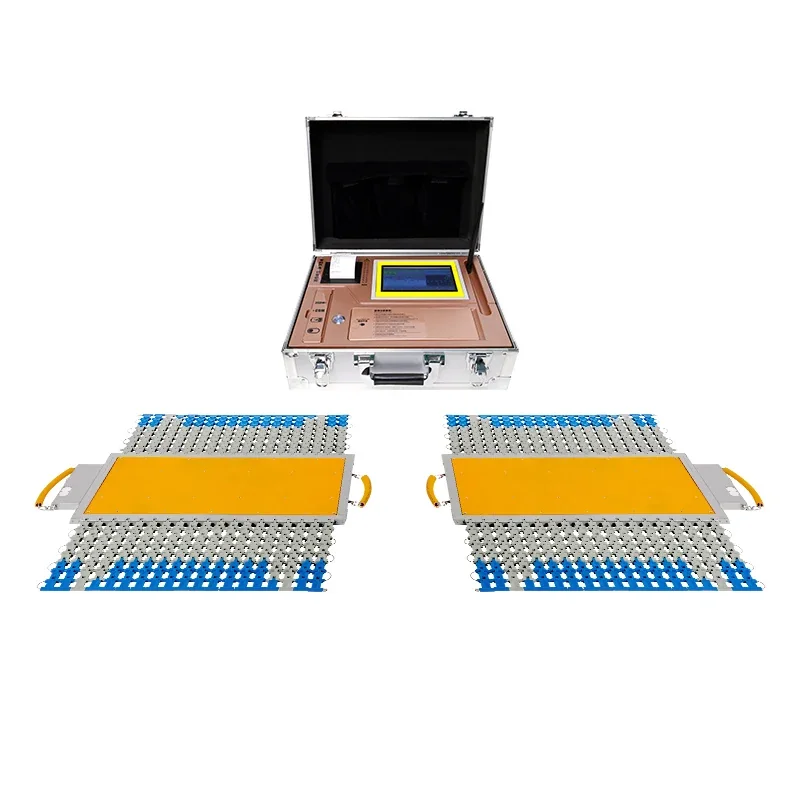
Use the portable axle scale buying guide for initial selection and field setup planning, and static axle scale vs WIM before choosing a moving-vehicle method. Review the portable axle scale family and submit the planned validation through the configuration form.
State the tested method before stating performance
Portable axle results depend on pad support, levelling, vehicle alignment, tyre contact, axle sequence, operator procedure, environment, reference method and the calculation used for the final result. Document those conditions before comparing performance claims.
- Separate static pad procedures from weigh-in-motion procedures
- Record the surface, ramps, pad layout and vehicle sequence
- Use representative vehicles and a suitable reference method
- Report the conditions and repeatability evidence with every acceptance result
Buyer-task questions
Why can the same pads give different results at another site?
Support, level, approaches, alignment, temperature, vehicle procedure and reference conditions can change. Reapprove the setup rather than transferring a result blindly.
Does a higher display resolution prove higher accuracy?
No. Display increment is only one characteristic; installed accuracy depends on the complete instrument, setup, procedure and verification evidence.
References
The following official and first-party sources support the bounded examples, standards context and evaluation methods used in this guide. They do not verify an FMSCales configuration.
- UK DVSA — Consolidated Code of Practice for Enforcement Weighing
- NIST Handbook 44 — Current Edition
- OIML R 76-1:2006 — Non-automatic Weighing Instruments
- OIML R 134-1:2006 — Weighing Road Vehicles in Motion
- Rice Lake — Load Ranger Wheel Weigh Pad System Technical Manual
- FHWA — Weigh-in-Motion Technology Overview
 Portable Axle Scales
 Truck Scales
 Weighing Indicators